
With the publication of the revised ISO 5459 in October 2024, which has also been available as DIN EN ISO 5459 since December 2025, there is now also the option of entering a reference coordinate system in the drawing in addition to the new default for the association.
From a functional point of view, references map the contacts in the assembly to the neighbouring components and bind the necessary degrees of freedom for the component. This creates the starting point for tolerancing, for example to define the location and direction of tolerance zones. Understanding the reference system is therefore crucial for the structure, tolerancing and interpretation of the specification. With the entry of a reference coordinate system, the updated standard has created an option that makes an important contribution to understanding the specification, as coordinate systems are already familiar from other areas and are part of everyday work both in the manufacturing environment and in metrology.
The prerequisite for entering a reference coordinate system in accordance with ISO 5459 is that all degrees of freedom of the component are bound. Unless otherwise specified, a Cartesian coordinate system is defined according to the right-hand method. As shown in the figure, all axes are labelled.
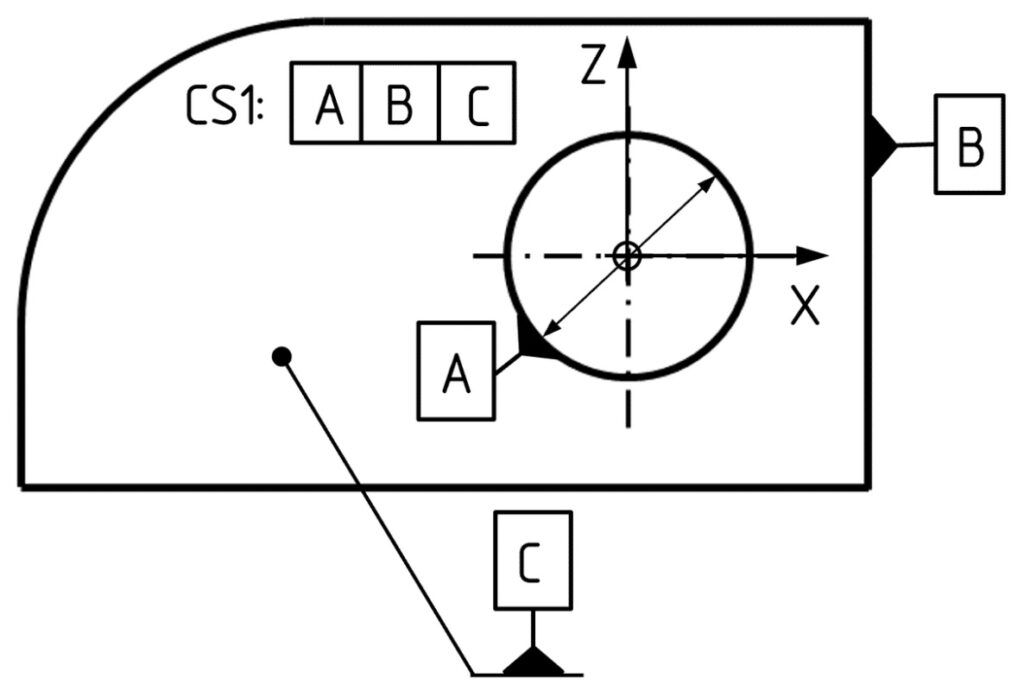
The datum coordinate system indicator can be displayed directly in the component at the coordinate origin. The datum coordinate system identifier is entered with CS and a unique positive number (several datum coordinate systems can also be defined) followed by a colon and, for example, the specification of the datum coordinate system directly on the component and near the title block. Other options, such as an indirect specification, are defined in the standard.
In our courses, we have already incorporated the relevant new features of ISO 5459 and introduced the entry of a reference coordinate system.