
The rules for tolerancing and measurement in the ISO GPS system apply in principle to rigid workpieces. This means that these parts do not deform by themselves unless additional forces are applied. It is therefore assumed that components have the same geometric properties in their unassembled state as they will have in their assembled state.
However, there are components that behave differently due to their own weight or residual stresses caused by the manufacturing process. As a result, additional deformations occur in these components that exceed the functional tolerances. Nevertheless, the parts are often suitable for their function and comply with the functional limits under certain conditions (mainly due to the forces applied during assembly). Components that exhibit this particular behaviour are referred to as non-dimensionally stable. These include, for example, plastic parts and thin sheet metal, for which an extended approach to tolerancing and a distinction between the assembled and unassembled state is essential.
The ISO 10579 standard from 2010 defines that both the „free“ and the „joined“ state can be differentiated and described by tolerances. The application of this standard and the additional conditions for the installed or „joined“ state must be specified by entering the standard and the additional conditions near the title block (see the following image for an example). Alternatively, reference can also be made to an applicable document.
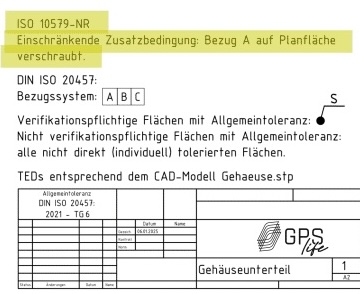
Drawing entry with reference to ISO 10579
In the technical drawing, the „free“ condition is characterised in accordance with this standard by an F in a circle behind the tolerance in the tolerance indicator or the dimensional tolerance. This means that all entries without the F in the circle must be evaluated in compliance with the additional conditions. Additional conditions define, for example, forces during measurement or screw connections with the counterpart, which can also be represented by a device.
In the following image, the surface of a component is tolerated with a flatness in the free state. It is to be expected that the surface provided with the registration will receive an additional significant deformation during assembly. The evaluation in the „free“ state offers an opportunity to recognise the resulting deformations before assembly in order to be able to assess subsequent functional fulfilment.
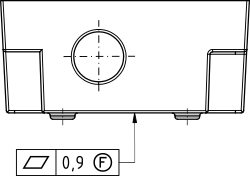
Entry of F in the circle in the tolerance indicator on the component
The explanation of the labelling of non-stable components is part of our new in-depth course „Tolerancing of moulded plastic parts“.
P.S. Work is currently underway on a new standard that is also dedicated to this topic and allows for further specifications. As soon as this standard is published, we will provide further information.